Wellness Wheel: Financial Wellness
Rewiring Your Relationship With Money
SELF CAREWELLNESS WHEEL
6/8/2026
Wellness Wheel: Financial Wellness
Rewiring Your Relationship With Money
Financial stress has been linked to increased inflammation, sleep problems, and even chronic disease.
Financial stability, on the other hand, increases mental capacity and decision-making abilities.
Dr. Peggy Swarbrick’s Eight Dimensions of Wellness paradigm addresses whole-being wellness and each week we will choose one dimension to explore. This week we focus on Financial Wellness:
Financial wellness is about how you feel about your financial condition, not just about how much money you have. It’s about your sense of security, control, and capacity to plan ahead of time.
How well do you understand your financial circumstance?
Have you handed over responsibility for your financial wellbeing to a partner or another trusted person?
What happens if that person is unavailable and you have a financial need?
Or if that person drops the ball and you are now in financial straits?
Do you understand enough about money management to pick up and carry on?
Do you pay your bills on time? Is it manageable or are you just scraping by?
Is retail therapy or online shopping your go to when you’re not feeling your best or have challenging emotions that you don’t want to face?
Or are you thrifty? And putting away every extra cent you can?
Financial wellness is about developing a relationship with money based on clarity, control, and confidence.
Our belief system around money stems from a psychological concept called money scripts—ingrained, subconscious beliefs formed in childhood based on our earliest observations, experiences, and family dynamics. These scripts dictate how we save, spend, and value ourselves financially.
Financial DNA is typically shaped by several core factors:
Childhood Observations: How parents handled stress, debt, and saving directly influences your habits. If money was scarce or a source of tension, you might develop a scarcity mindset. If money was flaunted, you might tie your self-worth to status.
Inherited Financial Scripts: Repeated phrases you heard growing up, such as "money doesn't grow on trees" or "rich people are greedy," can become permanent mental filters.
Cultural and Social Conditioning: Your community, religious background, and early peer interactions shape your moral views on wealth accumulation.
Early Financial Trauma: Unexpected financial losses, sudden windfalls, or experiences of poverty leave profound imprints on your nervous system, sometimes causing financial anxiety even when you are secure.
Understanding where your beliefs originate is the first step to untangling unhelpful habits.
Financial psychologists classify these core beliefs into four main categories:
Money Avoidance: Believing money is evil or that you don't deserve it, often leading to overspending or giving money away.
Money Worship: The belief that money will solve all your problems and buy happiness.
Money Status: Defining your personal worth strictly by your net worth.
Money Vigilance: Being highly focused on saving and secrecy, often stemming from anxiety about loss.
Small steps to take towards financial wellness:
Try observing, without judgment, where your money flows to help you create awareness of the comings and goings of every dollar belonging to you.
Determine your financial priorities: saving for the family, living your best life in the now, preparing for retirement.
Automate little weekly transfers into high interest savings or micro investing accounts; so when needed, you have easy access to a financial buffer if you don’t already have an active emergency fund.
Follow financial literacy resources that are relevant to your lived experience. There are many places that you can source information on managing your money eg. government websites and resources, facebook groups, reddit threads, links or blogs created by financial professionals or financial institutions.
Financial wellness isn’t about giving up all the tiny guilty pleasures that bring you joy; its about understanding the long term financial impact of regular habits so you can make conscious decisions in line with your priorities.
Basic Financial Goals to work towards:
Budgeting: Regularly tracking income and expenses.
Savings: Maintaining an emergency fund and consistently saving for the future.
Debt Management: Paying off debt on time and managing liabilities.
Financial Security: Planning for retirement and managing risk.
Goal Setting: Defining clear financial goals and creating a plan to reach them.
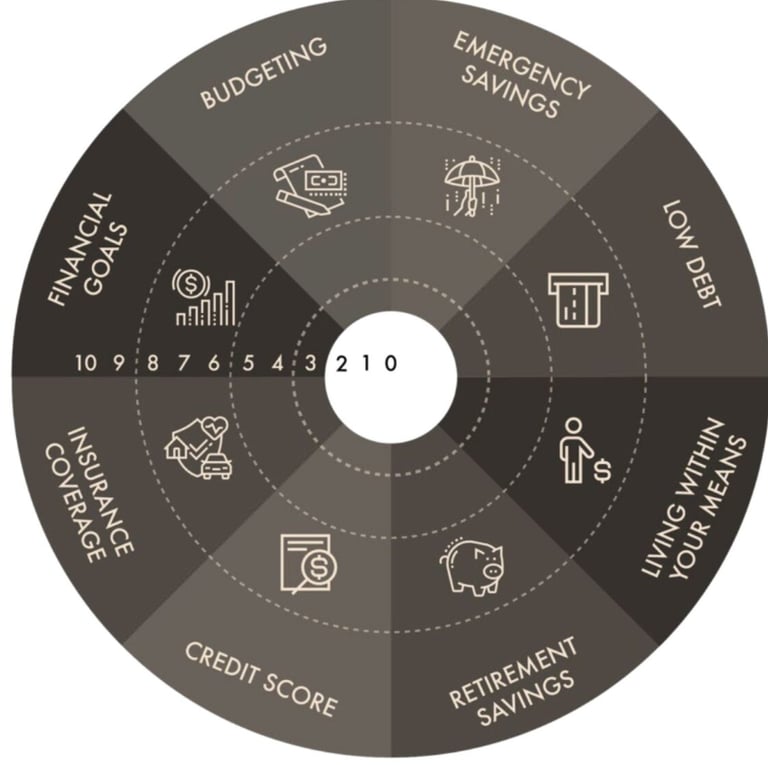
For those who have full control and awareness of their finances - why not look into the spokes of the Financial Wellness Wheel?
A Financial Wellness Wheel is a holistic self-assessment tool used to evaluate, balance, and improve key areas of personal finance, such as budgeting, debt management, savings, and financial security. It visualizes financial health as a wheel with multiple segments, helping you identify strengths and areas needing attention to reduce stress and build confidence long term in your financial wellness. While external obstacles are very real, tiny but powerful changes can generate significant momentum.
How to Use the Financial Wellness Wheel
Assess: Rate each segment of the wheel on a scale (e.g., 1-10) based on your current satisfaction or proficiency.
Visualize: Connect the scores to see where your "wheel" is unbalanced.
Reflect: Identify strengths and weaknesses without shame, recognizing areas for growth.
Act: Choose one or two specific areas to focus on for improvement with a plan.
Financial Wellness is intertwined with almost all of the other wellness dimensions so it is an important one to focus on and create a sense of safety (another core need from Maslow’s hierarchy).
To learn more about the 8 Dimensions of Dr Swarbrick’s Wellness Wheel and its practical applications, SAMHSA produces a Step-By-Step Guide to Wellness called Creating a Healthier Life. This guide has helpful resources to help you break down the dimensions of wellness and apply them to your lifestyle. You can use this workbook to more deeply understand the dimensions, to set goals, and develop an action plan for creating lifestyle habits that will strengthen your eight Dimensions of Wellness.
Ready to create Emotional Regulation to manage your stress around Finance?
Explore our structured programs designed to help you regulate your nervous system and support your gut.
The Nervous System Reset
Deep Self Care and Balance
Burnout Recovery
The Gut-Brain Axis
Parent Calm
Addressing Teen Anxiety
Claim your FREE Nervous System Regulation PDF explaining how your nervous system functions including regulation strategies.
Connect
with us
© gutsofthematter 2025. All rights reserved.
Mindfulness education is not medical or psychological treatment.
Seek professional advice for mental health concerns. © gutsofthematter, Victoria, Australia.